Rainforest Connection enlists machine learning to listen for loggers and jaguars in the Amazon
Rainforest Connection enlists machine learning to listen for loggers and jaguars in the Amazon
Rainforest Connection enlists machine learning to listen for loggers and jaguars in the Amazon
Rainforest Connection enlists machine learning to listen for loggers and jaguars in the Amazon
Rainforest Connection enlists machine learning to listen for loggers and jaguars in the Amazon
Rainforest Connection enlists machine learning to listen for loggers and jaguars in the Amazon
Rainforest Connection enlists machine learning to listen for loggers and jaguars in the Amazon
Rainforest Connection enlists machine learning to listen for loggers and jaguars in the Amazon
Rainforest Connection enlists machine learning to listen for loggers and jaguars in the Amazon
Rainforest Connection enlists machine learning to listen for loggers and jaguars in the Amazon
Rainforest Connection enlists machine learning to listen for loggers and jaguars in the Amazon
Rainforest Connection enlists machine learning to listen for loggers and jaguars in the Amazon
Rainforest Connection enlists machine learning to listen for loggers and jaguars in the Amazon
Rainforest Connection enlists machine learning to listen for loggers and jaguars in the Amazon
The vastness that makes the Amazon rainforest so diverse and fertile also makes it extremely difficult to protect. Rainforest Connection is a project started back in 2014 that used solar powered second-hand phones as listening stations that could alert authorities to sounds of illegal logging. And applying machine learning has supercharged the network’s capabilities.
The original idea is still in play: modern smartphones are powerful and versatile tools, and work well as wireless sound detectors. But as founder Topher White explained in an interview, the approach is limited to what you can get the phones to detect.
Originally, he said, the phones just listened for certain harmonics indicating, for example, a chainsaw. But bringing machine learning into the mix wrings much more out of the audio stream.
“Now we’re talking about detecting species, gunshots, voices, things that are more subtle,” he said. “And these models can improve over time. We can go back into years of recordings to figure out what patterns we can pull out of this. We’re turning this into a big data problem.”
White said he realized early on that the phones couldn’t do that kind of calculation, though — even if their efficiency-focused CPUs could do it, the effort would probably drain the battery. So he began working with Google’s TensorFlow platform to perform the training and integration of new data in the cloud.
Google also helped produce a nice little documentary about one situation where Guardians could help native populations deter loggers and poachers:
That’s in the Amazon, obviously, but Rainforest Connection has also set up stations in Cameroon and Sumatra, with others on the way.
Machine learning models are particularly good at finding patterns in noisy data that sound logical but defy easy identification through other means.
For instance, White said, “We should be able to detect animals that don’t make sounds. Jaguars might not always be vocalizing, but the animals around them are, birds and things.” The presence of a big cat then, might be easier to detect by listening for alarmed bird calls than for its near-silent movement through the forest.
The listening stations can be placed as far as 25 kilometers (about 15 miles) from the nearest cell tower. And since a device can detect chainsaws a kilometer away and some species half a kilometer away, it’s not like they need to be on every tree.
But, as you may know, the Amazon is rather a big forest. He wants more people to get involved, especially students. White partnered with Google to launch a pilot program where kids can build their own “Guardian,” as the augmented phone kits are called. When I talked with him it was moments before one such workshop in LA.
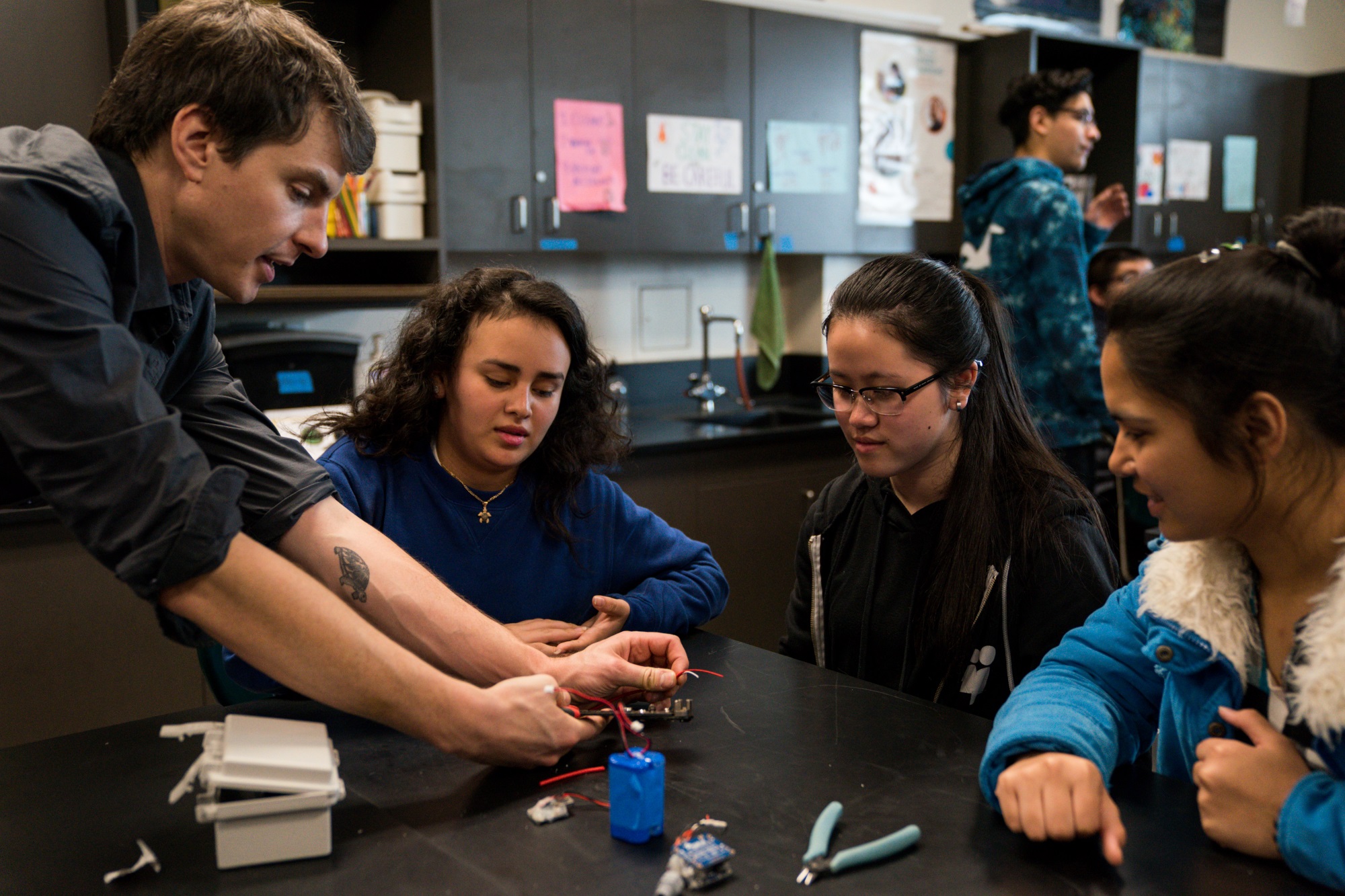
Topher White and students at one of the Guardian building workshops.
“We’ve already done three schools and I think a couple hundred students, plus three more in about half an hour,” he told me. “And all these devices will be deployed in the Amazon over the next three weeks. On Earth day they’ll be able to see them, and download to app to stream the sounds. It’s to show these kids that what they do can have an immediate effect.”
“An important part is making it inclusive, proving these things can be built by anyone in the world, and showing how anyone can access the data and do something cool with it. You don’t need to be a data scientist to do it,” he continued.
Getting more people involved is the key to the project, and to that end Rainforest Connection is working on a few new tricks. One is an app you’ll be able to download this summer “where people can put their phone on their windowsill and get alerts when there’s a species in the back yard.”
The other is a more public API; currently only partners like companies and researchers can access it. But with a little help all the streams from the many online Guardians will be available for anyone to listen to, monitor, and analyze. But that’s all contingent on having money.
“If we want to keep this program going, we need to find some funding,” White said. “We’re looking at grants and at corporate sponsorship — it’s a great way to get kids involved too, in both technology and ecology.”
Donations help, but partnerships with hardware makers and local businesses are more valuable. Want to join up? You can get at Rainforest Connection here.


from Gadgets – TechCrunch https://ift.tt/2IMwp8I
via Blogger https://ift.tt/2G0ltGX
March 24, 2018 at 12:48AM
via Blogger https://ift.tt/2pDCOKL
March 24, 2018 at 02:33AM
via Blogger https://ift.tt/2FXYgFg
March 24, 2018 at 05:33AM
via Blogger https://ift.tt/2IOMxH9
March 24, 2018 at 02:33PM
via Blogger https://ift.tt/2IOTXdp
March 24, 2018 at 05:33PM
via Blogger https://ift.tt/2ufZw10
March 24, 2018 at 08:33PM
via Blogger https://ift.tt/2pDu6fD
March 24, 2018 at 11:33PM
via Blogger https://ift.tt/2GmcMWY
March 25, 2018 at 02:33AM
via Blogger https://ift.tt/2DSC5uf
March 25, 2018 at 05:33AM
via Blogger https://ift.tt/2uqceuv
March 25, 2018 at 02:33PM
via Blogger https://ift.tt/2DTChJL
March 25, 2018 at 05:33PM
via Blogger https://ift.tt/2I41kMX
March 25, 2018 at 08:33PM
via Blogger https://ift.tt/2uf7zvi
March 25, 2018 at 11:33PM
via Blogger https://ift.tt/2pGm5q3
March 26, 2018 at 02:33AM
via Blogger https://ift.tt/2pEO36v
March 26, 2018 at 05:33AM



0 Comments